
Augustine, Addiction, and the Theology of Habit
Habit as punishment for sin

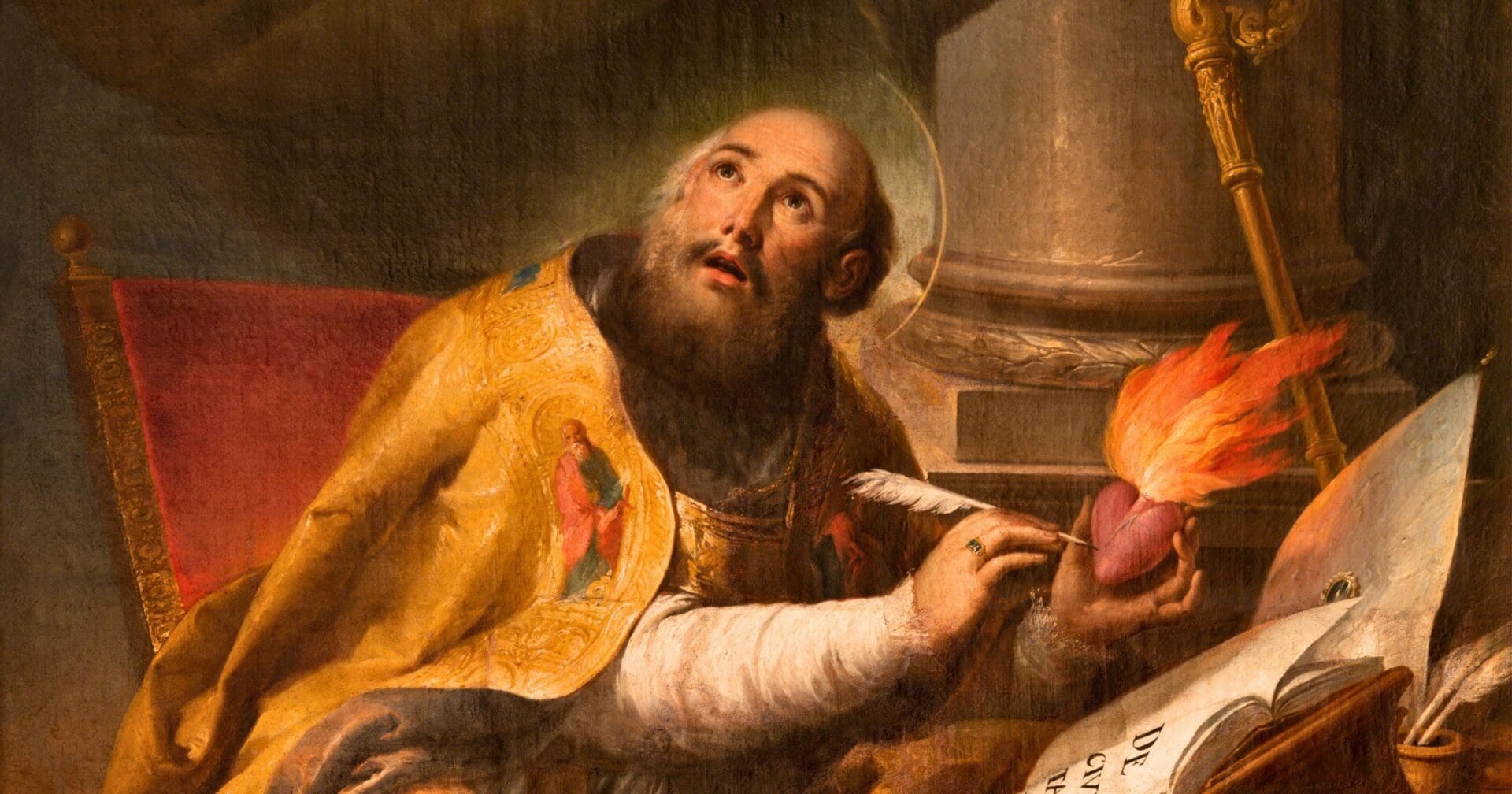
I’ve been reading St. Augustine’s The Confessions for the first time and finally came to Book VIII, on his conversion, where he describes his battle with habitual lust as the final obstacle to his conversion to Christianity, his final obstacle before turning his life entirely over to Christ.
At this point in the narrative, he was already intellectually convinced of the truth of Christianity. He had rejected the dualism of Manichaeism, overcame his objections against the crudity of certain Old Testament passages by the sublime preaching of St. Ambrose, read the Neoplatonists and came to understand the true metaphysics of an immaterial God, and resolved the problem of evil which had been plaguing him
The only thing standing in his way was his own sinful nature. To say I relate to this narrative is an understatement. Anyone familiar with my own late in life conversion story and struggle with the habitual sexual sin of autogynephilia knows there is a good reason I chose St. Augustine as my confirmation saint!
The impetus for his final conversion was listening to his friend Ponticianus describe the life of St Antony of the Desert, the heroic desert Father who gave up all his worldly possessions to flee into the desert, where he would heroically battle with the Devil against all kinds of fleshly temptation, setting the precedent and inspiration for the development of the Christian monastic and ascetic tradition.
Listening to this, St. Augustine could not help but be disgusted at himself for his own inability to conquer the concupiscence of his flesh. From here, he launches into a theological and psychological analysis of concupiscence to explain why he wants to live a life chastity but his mind is split in two such that another part of his mind continues to lust after carnal pleasure despite his overwhelming desire to live a life of virtue. He writes:
When I was making up my mind to serve the Lord my God at last, as I had long since purposed, I was the one who wanted to follow that course, and I was the one who wanted not to. I was the only one involved. I neither wanted it wholeheartedly nor turned from it wholeheartedly. I was at odds with myself, and fragmenting myself. This disintegration was occurring without my consent, but what it indicated was not the presence in me of a mind belonging to some alien nature but the punishment undergone by my own. In this sense, and this sense only, it was not I who brought it about, but the sin that dwelt within me as penalty for that other sin committed with greater freedom; for I was a son of Adam.
His analysis is strikingly Pauline in nature, echoing St. Paul’s famous comments in Romans 7 on struggling against his sinful nature:
So the trouble is not with the law, for it is spiritual and good. The trouble is with me, for I am all too human, a slave to sin. 15 I don’t really understand myself, for I want to do what is right, but I don’t do it. Instead, I do what I hate. 16 But if I know that what I am doing is wrong, this shows that I agree that the law is good. 17 So I am not the one doing wrong; it is sin living in me that does it.
18 And I know that nothing good lives in me, that is, in my sinful nature. I want to do what is right, but I can’t. 19 I want to do what is good, but I don’t. I don’t want to do what is wrong, but I do it anyway. 20 But if I do what I don’t want to do, I am not really the one doing wrong; it is sin living in me that does it. (Romans 7:14-20)
St. Augustine contrasts this Pauline theology with that of the Manichees, who saw this same bifurcation of the will and concluded there must be two natures within us: a good nature and an evil nature. St. Augustine rejects this on the same grounds he had already rejected the Manichee’s solution to the problem of evil, which was to attribute positive existence to evil as a countervailing force to that of God, who was Goodness itself.
St. Augustine struggled with the problem of evil for a long time, but it was learning from great Christian thinkers that he came to understand the truth of the matter, which was that evil is not a positive thing in its own right, but merely the privation of goodness with no independent existence of its own.
Accordingly, the existence of this duality of will in the battle against lust is not evidence for a duality of natures, but a sickness in his mind. What then explains the duality of wills? For St. Augustine explains it was “not him” who was committing these sins of lust, but his sin nature. This is identical to St. Paul’s claim that it was not him who was giving into temptation but “the sin living in him.”
[The will] cannot be identical with that thing which it is commanding to come into existence, for if it were whole and entire it would not command itself to be, since it would be already. This partial willing and partial non-willing is thus not so bizarre, but a sickness of the mind, which cannot rise with its whole self on the wings of truth because it is heavily burdened by habit. There are two wills, then, and neither is the whole: what one has the other lacks.
St. Augustine explains that it is not him who is choosing to give into lustful temptation, but the sheer force of habit inside him. He then goes on to explain the inner phenomenology of what it’s like to battle against this force of habit. In essence, what he is describing is the phenomenology of addiction. Indeed, the whole spiritual battle against temptation can be framed in terms of an addiction model: we become addicted to sin and therein enter into a battle of mind against mind.
He contrasts this struggle of the will with how easily and seamlessly the mind can will the body to, for example, raise a limb or move a leg, with the utter madness of willing oneself to not give into temptation but having your own mind resist this command with all its might:
The mind commands the body and is instantly obeyed; the mind commands itself, and meets with resistance. When the mind orders the hand to move, so smooth is the compliance that command can scarcely be distinguished from execution; yet the mind is mind, while the hand is body. When the mind issues its command that the mind itself should will something (and the mind so commanded is no other than itself), it fails to do so.
What then are we to make of free will? One might be tempted to think St. Augustine is making us out to be mere automatons wherein we can weasel out of any accountability for our sins by saying “the Devil made me do it.”
Doesn’t this seem to be St. Augustine and St. Paul trying to get themselves off the hook for their sinfulness and avoiding taking accountability for their actions? Not at all!
Indeed, he says, “it was not I who brought it about, but the sin that dwelt within me as penalty for that other sin committed with greater freedom; for I was a son of Adam.”
Here he is pointing to a dual causation: part of the force of his inner sin nature is due to the concupiscence owing to the fall of Adam and the resulting original sin which we all inherited, which brings us into this world already beset with disordered desires which incline us to sin.
But I also think St. Augustine’s point here is that when Christians struggle with our habitual sinful nature, we are dealing with the due consequences of having first used our free will to commit the sin in the first place prior to our conversion to Christ, and the resulting habitual nature and our struggle to resist it is a natural punishment intrinsic to our having used our will to disobey God.
That is to say, the order of operations in one’s spiritual life seems to be like this: We are born with both an inclination towards sin but also given free will. We then use our free will to choose to disobey God, despite the moral law written on our heart. These choices to sin then slowly wear down a groove or rut in the faculty of our will such that the sinfulness becomes totally habituated. And the very nature of habit itself then becomes such that it is nigh-impossible to resist by sheer human willpower. This is why St. Augustine calls this habit nature a “sickness of the mind” and a disintegration. I am reminded of our Lord Jesus’ admonition that, “Every kingdom divided against itself is laid waste, and no city or house divided against itself will stand.” (Matthew 12:25)
Freely choosing sin literally corrupts our mind and will, creating within us a brokenness that compounds upon our already existing concupiscence from original sin. This is the natural punishment intrinsic to the sin itself.
This idea of a natural punishment intrinsic to sin is a theme that runs throughout The Confessions. Indeed, he writes:
In this way you turned to my good the actions of those who were doing no good, and gave me my just deserts by means of my sin itself. Matters are so arranged at your command that every disordered soul is its own punishment.
So we freely choose to sin and the intrinsic punishment for this free choice is to poison and distort our own soul, hardening within us a habitual sin nature that we then are consigned to struggle against.
For the law of sin is that brute force of habit whereby the mind is dragged along and held fast against its will, and deservedly so because it slipped into the habit willingly. In my wretched state, who was there to free me from this death-doomed body, save your grace through Jesus Christ our Lord?
This aligns with the wisdom of recovery groups like Alcoholics Anonymous, who emphasize that they are alcoholics for life, and must therefore be on constant guard lest one trigger send them spiraling back into full blown relapse.
What then is the solution? If our lifetime of sin creates within us an unstoppable habit force of sinfulness that is nigh impossible to resist, should we therefore give up on striving for a life of perfect chastity?
By no means! And here is why St. Augustine is called the Doctor of Grace, for he is going to emphasize that the way out of this morass is by means of the Holy Spirit living in him, through Christ and in Christ. That is, it is only by sheer grace that we have any hope to escape this vicious cycle of struggle against sin. Indeed, in the same passage in Romans 7 St. Paul concludes:
Oh, what a miserable person I am! Who will free me from this life that is dominated by sin and death? Thank God! The answer is in Jesus Christ our Lord.
And indeed,
I have been crucified with Christ and I no longer live, but Christ lives in me. The life I now live in the body, I live by faith in the Son of God, who loved me and gave himself for me. (Galatians 2:20)
So I say, walk by the Spirit, and you will not gratify the desires of the flesh. (Galatians 5:16)
For if you live according to the flesh you will die, but if by the Spirit you put to death the deeds of the body, you will live. (Romans 8:13)
What St. Paul is saying that he cannot boast at all or take credit for his good works, for they come about only through the power of the Holy Spirit, who was sent by the Father and the Son, empowered by our faith and trust in Christ Jesus.
Do you not know that all of us who have been baptized into Christ Jesus were baptized into his death? We were buried therefore with him by baptism into death, so that as Christ was raised from the dead by the glory of the Father, we too might walk in newness of life. (Romans 6:3-4)
Indeed, St. Paul says it is entirely Christ Jesus who is our source of sanctification and life so that therefore, “Let him who boasts, boast of the Lord.” (1 Corinthians 1:30).
Many Protestants misunderstand this and claim that Catholicism preach a “works based religion” wherein it is our own human willpower that gets us into heaven.
But a close reading of St. Paul and St. Augustine completely repudiates such Pelagianism. Both St. Augustine and St. Paul repeatedly emphasis that it is only the unmerited grace of Christ Jesus who can empower us via the Holy Spirit to resist sin and walk in the newness of life.
This is why the whole “faith alone” vs “faith + works” debate is so misleading and counterproductive because they are two sides of the same coin.
Scripture is clear: faith without works is dead. It is both faith AND works which justifies us in the eyes of the Lord. Protestants are right to point out that we are saved by grace alone. Catholics are right to point out the importance of works, as Scripture is abundantly clear that we are justified by both faith and works. But where Protestants misunderstand the Catholic position is when they accuse Catholics of the Pelagian heresy that is our own human willpower which performs the works which justify us.
By no means! We are only able to do such good works through the power of the Holy Spirit, for we were completely dead in our sins. Accordingly, St. Paul says,
For it is by grace you have been saved, through faith—and this is not from yourselves, it is the gift of God—9 not by works, so that no one can boast. 10 For we are God’s handiwork, created in Christ Jesus to do good works, which God prepared in advance for us to do.
Protestants take St. Paul’s emphasis on nobody boasting to mean works play no role in justification. But justification just means be process whereby we are made righteous by God.
And works matter in that process! Which is why St. Paul says, “For he will render to every man according to his works” (Romans 2:6) and “For it is not the hearers of the law who are righteous before God, but the doers of the law who will be justified.” (Romans 2:13)
But Catholics do not claim we can do this all by ourselves through sheer human willpower. It is only by means of grace through the Holy Spirit that we can put to death our sinful nature and be reborn as new men in Christ.
And amen for that!
Thank you for posting this, I needed to read it today. I too struggle with the habits of so many years before opening myself up to God. It's a daily battle and can feel overwhelming at times. Stay strong in your faith, and may God bless you!
@Dylan Campbell @William E. @Jonathan Dunn check out this great essay by my close friend @Ray Alex Williams